Energy-Efficient Roofing: Cool Roof Shingles, Reflective Metal, and Attic Heat
Energy-efficient roofing can help Michigan homeowners manage indoor comfort and reduce energy waste, but the results depend on more than the roofing material alone. Roof color, insulation, ventilation, air sealing, attic design, and the home's heating and cooling systems all influence energy performance.
For homeowners researching Energy Efficient Roofing Michigan options, the key is understanding which improvements deliver measurable benefits in a climate with cold winters, warm summers, snow, ice, and changing seasonal temperatures. Cool roof shingles and reflective metal roofing may reduce summer heat gain under the right conditions, while proper attic insulation and air sealing often play a more significant role in winter energy savings.
This guide explains how energy-efficient roofing works, compares popular materials, and identifies improvements worth considering before investing in a roof replacement.
How Does Energy-Efficient Roofing Work in Michigan?
A roof affects energy performance by controlling how much solar heat enters the home, how well the building retains indoor warmth, and how moisture and heat move through the roof assembly.
During summer, sunlight heats the roof surface. Some of that heat transfers through the roof deck and into the attic. If the attic becomes excessively hot, heat can move into the living space, increasing the cooling load in homes with air-conditioned rooms below.
During winter, the challenge is different. Indoor heat can escape through poorly insulated ceilings, gaps around attic penetrations, and other parts of the building envelope. A reflective roof alone cannot prevent this heat loss.
Summer heat gain and roof reflectivity
Roofing materials differ in how much sunlight they reflect and how much absorbed energy they release as heat. A highly reflective roof can remain cooler in direct sunlight than a similar dark, less reflective roof.
The potential benefit depends on factors such as roof orientation, shading, insulation levels, attic ventilation, and the amount of air conditioning the household uses.
Winter heat retention and insulation
In Michigan, winter energy efficiency usually depends heavily on the quality of attic insulation and air sealing. Warm air escaping through ceiling gaps can carry heat into the attic, where it may contribute to higher heating costs and ice-dam problems under certain conditions.
Replacing an old roof may provide an opportunity to identify ventilation or moisture issues, but adding reflective roofing without addressing insulation deficiencies is unlikely to deliver substantial winter heating savings.
Cool Roof Shingles: Are They Worth It?
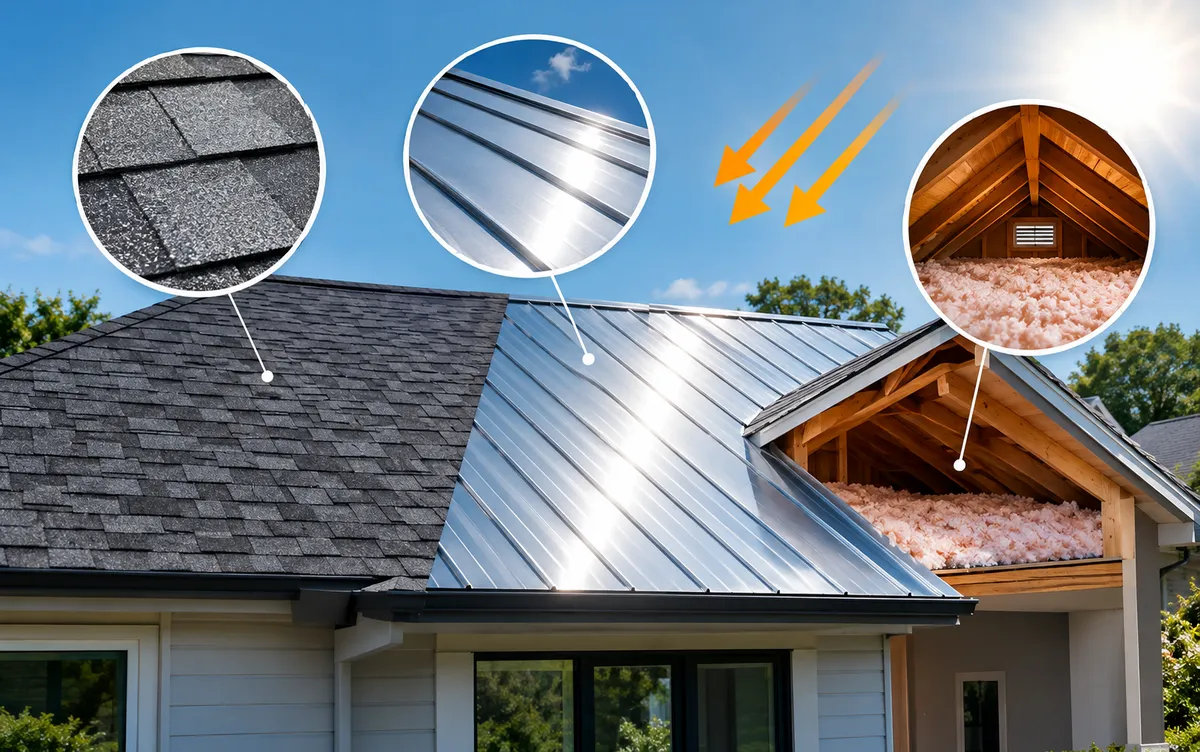
Cool roof shingles are designed to reflect more sunlight and absorb less solar energy than conventional roofing products. Some use specially formulated granules that improve solar reflectance while maintaining the appearance of traditional asphalt shingles.
These products can appeal to homeowners who want a familiar shingle appearance with improved summer performance.
Benefits of cool roof shingles
Reduced roof surface temperatures: Higher solar reflectance can reduce the amount of heat absorbed by the roof.
Potential cooling savings: Homes with air conditioning may benefit from lower heat transfer into the attic and living space.
Familiar appearance: Many products resemble conventional architectural asphalt shingles.
Product variety: Homeowners can compare different colors, performance ratings, warranties, and price points.
However, not every shingle marketed as energy-efficient delivers the same performance. Darker and lighter products can have different reflectance values, and product specifications matter more than general marketing descriptions.
What about ENERGY STAR roofing?
When evaluating an energy-efficient roofing product, check its current certification status and technical documentation rather than relying on an ENERGY STAR logo in advertising. ENERGY STAR's roofing product certification program was discontinued in 2022, so homeowners should not assume a newly marketed product qualifies under a current ENERGY STAR roofing category.
Instead, compare documented solar reflectance, thermal emittance, applicable Cool Roof Rating Council ratings, manufacturer specifications, and any available local energy requirements.
Cool roof shingles can be worthwhile, particularly for homes with significant summer cooling demand. Their financial benefits in Michigan may be more modest than in hotter climates, especially where air conditioning use is limited.
Reflective Metal Roofing: A Durable Energy-Efficient Option
Metal roofing is another option for homeowners comparing energy-efficient roofing in Michigan. Depending on the finish, coating, color, and roof design, metal panels can provide strong solar reflectance and release absorbed heat effectively.
Metal roofing is available in standing-seam panels, corrugated profiles, and metal shingles. Each system has different installation requirements, appearance, durability characteristics, and price points.
How reflective metal roofing reduces heat gain
A reflective metal roof sends a portion of incoming solar radiation back toward the atmosphere rather than absorbing all of it. Certain finishes also have high thermal emittance, helping the roof release absorbed heat.
The result can be a cooler roof surface during sunny weather. How much that changes indoor temperatures and utility bills depends on the complete roof assembly and the home's cooling demand.
Metal roofing does not automatically outperform every asphalt shingle roof. A reflective metal product may offer advantages over a dark, low-reflectance shingle, but the comparison depends on the actual products being evaluated.
Additional advantages of metal roofing
Long service life: Properly selected and installed metal roofing can last for decades.
Weather resistance: Suitable systems can perform well under Michigan's rain, snow, and seasonal temperature changes.
Finish choices: Homeowners can compare reflective coatings and colors to balance appearance and performance.
Maintenance considerations: Metal roofing can reduce some maintenance needs, although fasteners, flashing, sealants, and other components still require attention.
Metal roofing typically costs more upfront than standard asphalt shingles. A decision should consider installation costs, expected service life, maintenance, energy performance, and the homeowner's long-term plans.
For a detailed comparison of metal roof styles, installation requirements, and benefits, visit our [Metal Roof Installation in Michigan guide — insert link to the metal roofing pillar page].
Attic Heat: The Often-Overlooked Part of Roofing Efficiency
A reflective roof can reduce solar heat absorption, but the attic plays a major role in determining how that heat affects the home.
An attic with insufficient insulation, uncontrolled air leakage, or poorly designed ventilation may contribute to uncomfortable rooms and avoidable energy use. Addressing these problems can provide more practical benefits than replacing otherwise serviceable roofing solely for energy savings.
Improve attic insulation
Insulation slows heat transfer between the living space and the attic. In winter, adequate insulation helps keep heated indoor air from losing warmth through the ceiling. In summer, it helps limit the transfer of attic heat into rooms below.
The appropriate insulation level depends on the home's construction, existing insulation, and applicable energy recommendations. A professional assessment can identify thin areas, compressed insulation, and gaps that need attention.
Seal air leaks before adding insulation
Air sealing and insulation work best together. Common leakage points include attic hatches, plumbing penetrations, electrical wiring openings, recessed fixtures, and gaps around ceiling framing.
Sealing these areas can reduce unwanted air movement and help the insulation perform as intended. Work near chimneys, flues, recessed lights, and other heat-producing equipment must follow applicable fire-safety clearances and manufacturer requirements.
Understand attic ventilation
Properly designed attic ventilation can help manage moisture and temperature conditions, but ventilation is not a substitute for insulation or air sealing.
The correct system depends on the roof's design, available intake and exhaust openings, and the overall building assembly. Simply adding more vents may not solve an overheating attic and can create airflow problems if the system is poorly balanced.
In cold climates, uncontrolled warm, moist air entering the attic can contribute to condensation and frost accumulation. A roofing professional should assess ventilation alongside insulation, air leakage, and moisture management rather than treating ventilation as an isolated fix.
What Is a Radiant Barrier, and Does Michigan Need One?
A radiant barrier is a reflective material, commonly installed facing an air space, that reduces radiant heat transfer. It is often used in hot-climate attics to limit heat radiating from a hot roof toward the attic floor.
Radiant barriers work differently from conventional insulation. Insulation slows conductive and convective heat transfer, while a radiant barrier reduces radiant heat transfer when installed correctly.
When a radiant barrier may help
A radiant barrier may be worth evaluating in a home with substantial summer attic heat gain and meaningful air-conditioning use. Its performance depends on installation orientation, the presence of an appropriate air space, dust accumulation, and the overall attic design.
Michigan homeowners should weigh the potential summer benefit against installation costs and other available improvements.
When other upgrades should come first
If an attic has insufficient insulation or major air leaks, addressing those issues will often be a higher priority. Radiant barriers do not replace thermal insulation, and they generally offer less value when cooling demand is low.
Before purchasing a radiant barrier, ask a qualified contractor to assess the attic and explain how the proposed installation is expected to improve performance in your particular home.
Energy-Efficient Roofing Materials Compared
The best roofing choice depends on your budget, existing roof condition, home design, and energy goals.
Roofing option | Main energy advantage | Important limitation |
|---|---|---|
Cool roof shingles | Can reduce solar heat absorption compared with less reflective shingles | Savings depend on cooling demand and attic conditions |
Reflective metal roofing | Certain finishes reflect sunlight and release absorbed heat effectively | Higher initial cost and product-specific performance |
Conventional asphalt shingles | Widely available in many colors and price ranges | Dark, less reflective products can absorb more solar energy |
Radiant barrier | Can reduce radiant heat transfer in suitable attic assemblies | Does not replace insulation or air sealing |
Attic insulation and air sealing | Reduces heat transfer and uncontrolled air leakage | Requires proper assessment and installation |
No single option guarantees a particular reduction in energy bills. Product specifications, installation quality, climate, utility rates, and household energy use all affect the outcome.
How Much Can Energy-Efficient Roofing Save on Heating and Cooling Bills?
There is no reliable universal percentage for how much a Michigan homeowner will save by installing a reflective roof. Any estimate should account for the existing roof, attic insulation, air-conditioning usage, heating system, energy prices, and the proposed materials.
A reflective roof may offer a meaningful summer benefit when replacing a dark, heat-absorbing roof on a home with substantial cooling demand. A homeowner who rarely uses air conditioning may see a smaller financial return.
Winter heating savings are more complicated. Reflective roofing does not provide the same benefit in winter as improved insulation and air sealing, and reducing solar heat absorption may not be advantageous in every winter condition.
Calculate the full cost, not just the energy savings
Before choosing a roofing upgrade, consider:
The additional upfront cost compared with a standard replacement roof.
The expected service life and maintenance requirements of each material.
The likely reduction in cooling or heating energy use, based on the home's conditions.
Whether attic insulation, air sealing, or ventilation improvements are also needed.
Available rebates, financing, or incentives that can be confirmed for the specific project.
A simple payback estimate divides the additional project cost by the expected annual energy-cost savings. Because savings can vary substantially, use a conservative estimate and avoid treating a manufacturer's best-case performance figures as a guaranteed result.
For many homes, the strongest financial decision is to combine a suitable roofing material with targeted improvements to the building envelope.
How to Choose the Right Energy-Efficient Roof in Michigan
A practical decision starts with the condition of the existing roof and the home's most important energy problems.
1. Inspect the existing roof and attic
Determine whether the roof needs replacement because of age, leaks, storm damage, or deteriorating materials. At the same time, inspect the attic for insulation gaps, moisture, air leakage, and ventilation concerns.
If the roof remains in good condition, replacing it early solely for potential energy savings may not be financially justified.
2. Compare documented product performance
Ask contractors for the specific roofing product name, color, solar reflectance information, thermal emittance data, warranty details, and installation specifications. Compare products on consistent criteria rather than broad claims that a roof is “energy efficient.”
3. Consider Michigan's seasonal weather
The roof must perform through freezing temperatures, snow, rain, summer sun, and repeated seasonal changes. Flashing, underlayment, ice-barrier provisions where required, and correct installation are essential to long-term performance.
Reflectivity should be one part of the decision, not the only selection criterion.
4. Review the entire roof installation plan
Even a high-performance roofing product can underperform if installation details are incorrect. Proper fastening, flashing, drainage, ventilation, and compliance with applicable building codes all matter.
Learn more about materials, preparation, and project planning in our [Roof Installation in Michigan guide — insert link to the roof installation pillar page].
5. Get an itemized estimate
Request separate pricing for the roofing material, tear-off, underlayment, flashing, ventilation work, and any recommended attic upgrades. This makes it easier to identify which improvements address energy performance and which are necessary for roof durability.
Frequently Asked Questions
Are cool roof shingles worth it in Michigan?
Cool roof shingles may be worthwhile when summer heat gain and air-conditioning use are significant. Their financial value depends on the home's insulation, attic design, existing roofing material, and cooling demand. They are not guaranteed to produce substantial savings in every Michigan home.
Is metal roofing more energy-efficient than asphalt shingles?
Some reflective metal roofing products can absorb less solar heat than conventional dark asphalt shingles. However, performance depends on the specific finishes, colors, and roof assembly. A properly installed asphalt shingle roof with a reflective finish may also perform well.
Does a reflective roof reduce winter heating bills?
A reflective roof is primarily designed to reduce solar heat absorption, particularly during sunny weather. Winter heating bills are generally influenced more by insulation, air sealing, windows, and heating-system efficiency. A reflective roof should not be considered a replacement for these measures.
What is the best way to reduce attic heat in summer?
Start by evaluating attic insulation, air leakage, and ventilation. A reflective roof or radiant barrier may provide additional benefits under suitable conditions, but the best approach depends on the home's construction and cooling requirements.
Can energy-efficient roofing prevent ice dams?
No roofing material can guarantee ice-dam prevention. Ice dams can form when heat escapes into the attic, warms the roof, and melts snow that refreezes near colder eaves. Air sealing, adequate insulation, appropriate ventilation, and correctly installed ice-barrier protection can help address contributing factors.
Does a new roof automatically lower energy bills?
Not necessarily. A new roof may improve summer performance if the replacement material is more reflective, but the savings depend on the previous roof and the entire building assembly. If the home has significant insulation or air-leakage problems, those issues may need separate attention.