Metal Roof Installation in Michigan: Standing Seam vs. Corrugated vs. Metal Shingles
Metal roofing has become a popular choice for Michigan homeowners who want a durable roof that can handle snow, freezing temperatures, rain, wind, and seasonal temperature changes. But choosing metal is only the first step. The type of metal roof, fastening system, snow-retention setup, insulation, ventilation, and installation quality can all affect how well the roof performs.
If you are comparing options for metal roof installation in Michigan, three systems deserve particular attention: standing seam metal roofing, corrugated metal panels, and metal shingles. Each has different advantages, costs, appearances, and installation requirements.
The right choice depends on your home's design, roof slope, exposure to snow and ice, budget, and how long you plan to stay in the property.
Why Metal Roofing Works Well in Michigan
Michigan roofs have to withstand demanding weather conditions. Heavy snow, freeze-thaw cycles, ice, rain, strong winds, and temperature fluctuations can place significant stress on roofing materials.
Metal roofing can be particularly well suited to these conditions when it is properly designed and installed.
A quality metal roof can provide:
Long service life
Strong resistance to wind and precipitation
Effective snow shedding
Low routine maintenance requirements
Resistance to rot and insect damage
A wide range of colors and styles
Compatibility with modern insulation and ventilation systems
However, metal roofing is not automatically a better choice simply because it is metal. The roof system must be properly engineered for the building and local weather conditions.
Installation details matter just as much as the material itself.
Standing Seam vs. Corrugated vs. Metal Shingles
The three main metal roofing styles have noticeably different designs.
Feature | Standing Seam | Corrugated Metal | Metal Shingles |
|---|---|---|---|
Appearance | Modern, clean lines | Ribbed or agricultural/industrial look | Traditional shingle appearance |
Fastening | Often concealed | Usually exposed | Concealed or integrated fastening |
Snow performance | Excellent when properly designed | Good with proper installation | Good |
Maintenance | Low | Low to moderate | Low |
Typical lifespan | 40–70+ years | 30–50+ years | 40–70+ years |
Best for | Modern and long-term applications | Budget-conscious applications | Traditional residential appearance |
Visual style | Contemporary | Industrial/traditional | Residential/traditional |
Actual lifespan depends on the metal, coating, environment, installation quality, ventilation, maintenance, and exposure.
Standing Seam Metal Roof
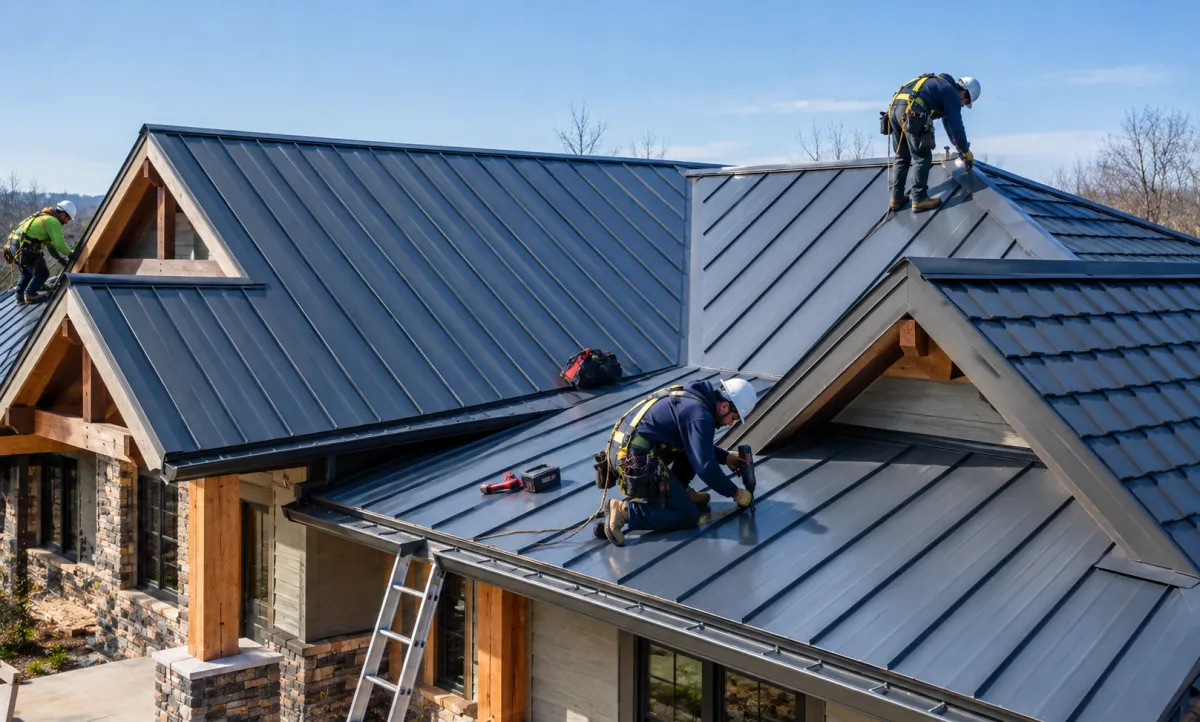
A standing seam metal roof uses long panels with raised vertical seams. The panels are commonly attached using concealed clips or fasteners, which keeps many attachment points protected from direct weather exposure.
This system is especially attractive for homeowners who want a clean architectural appearance and long-term durability.
Advantages can include:
Concealed fastening
Strong weather resistance
Minimal exposed hardware
Long service life
Expansion and contraction accommodation when properly designed
Modern appearance
Compatibility with snow-retention systems
Standing seam systems can be particularly useful for Michigan homes because roof panels can be designed to handle significant snow and temperature changes.
However, installation requires precision. Panel layout, clips, seams, penetrations, flashing, and snow-retention components all need to be properly coordinated.
Corrugated Metal Roofing
Corrugated metal roofing uses repeating ridges and valleys across the panel. It is one of the more recognizable metal roofing styles and can be used on residential, agricultural, commercial, and outbuilding applications.
Corrugated panels can offer:
Lower material costs than some premium metal systems
Simple panel profiles
Good strength-to-weight characteristics
A distinctive appearance
Relatively straightforward installation
The primary consideration is the fastening system. Many corrugated metal roofs use exposed fasteners, meaning screws and washers are visible on the roof surface.
Those fasteners need to be installed correctly and maintained over time. Improper installation can create opportunities for leaks, especially around penetrations and fastener locations.
Metal Shingles
Metal shingles are designed to provide the appearance of traditional roofing materials while offering many of the durability characteristics associated with metal.
They can resemble:
Asphalt shingles
Slate
Wood shakes
Tile
This makes them a useful option for homeowners who want metal's longevity without the appearance of large vertical panels.
Metal shingles may also be appropriate when a homeowner wants a more traditional architectural appearance that complements an older or historically styled home.
How Metal Roof Installation Works
Professional metal roof installation in Michigan involves considerably more than placing panels over the existing roof.
The installation process generally includes several stages.
1. Roof Inspection
Before installation begins, the contractor evaluates the existing roof structure, decking, flashing, ventilation, roof slope, penetrations, and overall condition.
The structural system should be capable of supporting the selected roofing assembly and expected environmental loads.
2. Removal or Preparation of Existing Roofing
Depending on the project, the existing roofing may be removed before the metal system is installed.
The contractor should inspect the roof deck for:
Rot
Water damage
Weak areas
Damaged sheathing
Previous leak damage
Any structural or decking issues should be addressed before the new roof is installed.
3. Underlayment Installation
Underlayment provides an additional protective layer beneath the metal panels.
The specific underlayment depends on the roof design and manufacturer requirements. Areas around valleys, penetrations, eaves, and other vulnerable locations may require additional waterproofing measures.
4. Flashing and Edge Details
Flashing is critical around areas where water could enter the roofing system.
These areas include:
Chimneys
Skylights
Valleys
Roof-to-wall intersections
Vents
Eaves
Rakes
Roof penetrations
Poor flashing installation can cause leaks even when the metal panels themselves are high quality.
5. Panel or Shingle Installation
The selected metal roofing system is then installed according to the manufacturer's specifications.
Fasteners, clips, seams, overlaps, panel alignment, and spacing must all be correct.
6. Snow Retention Installation
Michigan homeowners should give special consideration to snow retention.
Rather than allowing large quantities of snow and ice to slide from a roof at once, properly designed metal roof snow guards or snow-retention systems can help control snow release.
The system should be designed for the roof profile, slope, expected snow conditions, and areas below the roof.
Metal Roof Snow Guards: Why They Matter in Michigan
Metal roofs can allow snow to slide more easily than rougher roofing surfaces.
That can be beneficial because snow does not necessarily remain on the roof for as long. However, uncontrolled snow release can create hazards.
Falling snow or ice can damage:
Gutters
Landscaping
Vehicles
Decks
Lower roofs
Walkways
People and pets
Metal roof snow guards help manage this risk by holding snow and ice on portions of the roof so that melting and release occur more gradually.
Types of Snow Retention Systems
Depending on the roof, contractors may use:
Individual snow guards
Continuous snow rails
Snow fences
Bar-style retention systems
The correct system depends on the roofing profile and project requirements.
Snow guards should not simply be added wherever they look appropriate. Their placement and attachment need to be compatible with the metal roofing manufacturer and the roof design.
How Metal Roofs Are Fastened
Fastening is one of the most important differences between metal roofing systems.
Exposed Fasteners
Corrugated and other exposed-fastener systems typically use screws driven through the roofing panel.
The fasteners usually include washers designed to create a weather-resistant seal.
Correct installation is important because over-tightening can damage the washer or panel, while under-tightening can compromise the seal.
Concealed Fasteners
Standing seam systems commonly use clips or other concealed fastening methods.
This reduces the number of exposed penetration points on the roof surface and creates a cleaner appearance.
The fastening system also needs to account for thermal movement.
Metal expands and contracts as temperatures change. A properly designed system allows the panels to move without compromising the roof assembly.
How Long Does a Metal Roof Last?
The metal roof lifespan depends on several factors rather than the material alone.
A properly installed metal roof can potentially last several decades, with some systems lasting 40 years, 50 years, 70 years, or longer depending on the material and conditions.
Important lifespan factors include:
Metal type
Coating quality
Installation quality
Roof ventilation
Local weather exposure
Maintenance
Fastener quality
Snow and ice conditions
Corrosion exposure
Flashing quality
A premium metal roof installed incorrectly may perform worse than a more affordable system installed properly.
That is why homeowners should evaluate both the roofing material and the contractor's installation practices.
Does a Metal Roof Make Noise?
One of the most common concerns about metal roofing is metal roof noise.
People sometimes assume that rain or hail will sound extremely loud inside a home with a metal roof.
In reality, the sound level depends heavily on the complete roof assembly.
Insulation, underlayment, attic construction, decking, and the interior ceiling all influence how much exterior sound reaches the living space.
Why Metal Roofs Are Not Necessarily Loud
A metal panel installed as part of a properly constructed residential roof assembly is not the same as a bare sheet of metal installed over an open structure.
Modern residential assemblies can include:
Roof decking
Underlayment
Insulation
Air barriers
Attic space
Interior ceiling materials
These layers can substantially reduce sound transmission.
If noise is a major concern, discuss the complete roof assembly with your contractor rather than judging the material by itself.
Standing Seam vs. Corrugated Metal: Which Is Better?
Neither system is universally better.
Standing seam is often attractive for homeowners prioritizing long-term performance, concealed fastening, and a clean appearance.
Corrugated metal can be a practical choice when upfront cost, panel simplicity, or a specific architectural style is more important.
Choose Standing Seam If You Prioritize
Long-term durability
Concealed fasteners
Modern appearance
Strong weather resistance
A premium residential roofing system
Reduced exposed fastening points
Choose Corrugated Metal If You Prioritize
Simpler panel construction
Lower initial cost
Traditional or industrial appearance
Use on certain residential or accessory structures
A qualified metal roofing contractor in Rochester Hills or elsewhere in Michigan can evaluate your roof and explain which system is appropriate for the home's design and exposure.
Metal Shingles vs. Standing Seam
Metal shingles and standing seam systems can both provide long service lives, but they offer very different appearances.
Metal shingles are often better suited to homeowners who want their roof to resemble conventional residential roofing.
Standing seam is generally more visually distinctive, with long vertical panel lines that create a contemporary appearance.
The choice often comes down to:
Architectural style
Budget
Desired appearance
Roof complexity
Maintenance expectations
Snow-management requirements
What Should You Ask a Metal Roofing Contractor?
Before signing a contract, ask detailed questions about the complete roofing system.
Ask About the Metal
Find out:
What type of metal is being used?
What gauge is the material?
What coating does it have?
What warranty is provided?
How is corrosion resistance addressed?
Ask About Installation
Ask:
Will the existing roof be removed?
Will the decking be inspected?
What underlayment will be installed?
How will penetrations be flashed?
How will thermal movement be accommodated?
Which fasteners or clips will be used?
Ask About Snow Management
Michigan homeowners should specifically ask:
Are snow guards needed?
Where will they be installed?
How will they be attached?
Are they compatible with the roofing system?
How will snow release be controlled above entrances and walkways?
Ask About the Warranty
Understand the difference between:
Material warranties
Paint or coating warranties
Workmanship warranties
Manufacturer requirements
A warranty may have specific installation requirements, so the contractor should be able to explain what is covered and for how long.
How Much Does Metal Roof Installation Cost?
The cost of metal roof installation depends on the roof's size, complexity, material, labor requirements, existing roof condition, flashing, ventilation, insulation, snow-retention requirements, and selected metal system.
Standing seam generally represents a different investment than basic exposed-fastener corrugated panels or metal shingles.
Factors that can increase project costs include:
Complex roof geometry
Multiple roof penetrations
Chimneys and skylights
Damaged decking
Tear-off requirements
Premium metal finishes
Additional insulation
Snow-retention systems
Custom flashing
Difficult site access
For a more detailed breakdown, see the metal roof installation cost guide.
Metal Roofing and Michigan's Winter Conditions
Winter performance should be one of the main considerations when selecting a metal roofing system in Michigan.
The roof should be designed to handle snow loads while also managing melting and refreezing.
Proper attic ventilation and insulation can help reduce temperature differences that contribute to ice-dam conditions.
However, roofing material alone does not eliminate ice dams.
A complete roofing strategy should consider:
Insulation
Ventilation
Air sealing
Underlayment
Roof geometry
Eave details
Snow retention
Flashing
Common Metal Roofing Installation Mistakes
Even high-quality metal roofing can develop problems when installation is rushed or improperly planned.
Incorrect Fastener Installation
Over-driven, under-driven, or poorly positioned fasteners can compromise weather resistance.
Poor Flashing
Flashing failures around chimneys, skylights, walls, and roof penetrations can lead to water intrusion.
Ignoring Thermal Movement
Metal expands and contracts with temperature changes. The system needs to accommodate that movement.
Improper Snow Guard Placement
Snow retention systems must be engineered for the roof rather than installed as an afterthought.
Inadequate Ventilation
A metal roof does not automatically solve attic moisture or temperature problems. The underlying ventilation system still matters.
Mixing Incompatible Materials
Certain metals and fasteners can create corrosion problems when incompatible materials are placed together.
Is Metal Roofing Worth It in Michigan?
For many Michigan homeowners, metal roofing can be a strong long-term investment.
The initial installation cost may be higher than some conventional roofing materials, but a properly installed metal roof can offer decades of service with relatively low routine maintenance.
The most important consideration is choosing the right system for the home rather than simply choosing the cheapest metal option.
Standing seam, corrugated panels, and metal shingles each have a place in residential roofing.
The best choice depends on your home's architecture, budget, roof design, snow exposure, desired lifespan, and installation requirements.
How to Choose the Right Metal Roof
Use these questions to narrow down your options:
How much snow does the property typically receive?
Does the roof require snow retention?
Do you prefer a modern or traditional appearance?
Is concealed fastening important?
How long do you expect to own the home?
What is your installation budget?
Does the existing decking need replacement?
How complex is the roof?
What type of warranty does the contractor provide?
Does the proposed system meet the manufacturer's installation requirements?
Getting these questions answered before installation can prevent expensive problems later.
Related Michigan Roofing Resources
For homeowners researching a complete roofing project, explore the related resources in this cluster:
Metal Roofing Materials Guide — Compare the different materials and coatings available for metal roofing.
Metal Roof Types and Style— Explore additional metal roofing profiles and residential applications.
Metal Roof Snow Guards Guide — Learn how snow-retention systems work and when they may be needed.
Metal Roof Lifespan and Maintenance — Understand how installation and maintenance affect long-term
Frequently Asked Questions
What is the best type of metal roof for Michigan?
Standing seam metal roofing is often a strong choice for Michigan because it offers concealed fastening, durable panel construction, and good resistance to snow and changing temperatures. However, corrugated metal and metal shingles can also be appropriate depending on the home's design, budget, and installation requirements.
How long does a metal roof last in Michigan?
A properly installed metal roof can last 40 to 70 years or longer, depending on the metal type, coating, installation quality, maintenance, ventilation, and exposure to Michigan's weather. The expected metal roof lifespan should be evaluated based on the complete roofing system rather than the panels alone.
Are metal roof snow guards necessary in Michigan?
Metal roof snow guards may be necessary when falling snow and ice could create a hazard or damage property. They can help control snow release from sloped metal roofs, particularly above entrances, walkways, decks, and areas where people or vehicles are present.
Is a standing seam metal roof better than corrugated metal roofing?
Neither system is automatically better for every property. A standing seam metal roof typically offers concealed fasteners and a cleaner appearance, while corrugated metal can provide a simpler and potentially more economical option. The best choice depends on the roof design, budget, appearance, and expected performance.
Are metal roofs noisy when it rains?
Metal roofs are not necessarily noisy inside a properly constructed home. Underlayment, roof decking, insulation, attic space, and the interior ceiling can significantly reduce sound transmission. The overall roof assembly has a greater effect on metal roof noise than the metal panels alone.
How much does metal roof installation cost in Michigan?
The cost of metal roof installation in Michigan varies based on roof size, metal type, roof complexity, labor, existing roof condition, flashing, ventilation, insulation, and snow-retention requirements. Standing seam, corrugated panels, and metal shingles can have different installation costs.
Can a metal roof handle heavy snow?
Yes. A properly designed and installed metal roofing system can handle significant snow loads. The roof structure, slope, panel system, fastening method, and local snow conditions should all be considered when designing the roof.
Does a metal roof make ice dams worse?
A metal roof does not automatically cause ice dams. Ice-dam formation is influenced by heat loss, insulation, ventilation, air sealing, roof design, and winter conditions. A properly designed roof assembly can help reduce the conditions that contribute to ice dams.
Do metal roofs need special maintenance?
Metal roofs generally require relatively little routine maintenance, but periodic inspections can help identify loose fasteners, damaged coatings, blocked drainage, flashing problems, or issues with snow-retention components. Maintenance requirements depend on the specific roofing system.
How do I choose a metal roofing contractor in Michigan?
Look for a contractor with experience installing the specific metal roofing system you are considering. Ask about previous projects, manufacturer-approved installation practices, warranties, flashing details, fastening methods, snow-retention systems, and how the contractor handles decking and ventilation.
What should I ask a metal roofing contractor before installation?
Ask what type and gauge of metal will be used, which coating is applied, how the roof will be fastened, what underlayment and flashing will be installed, whether snow guards are needed, how thermal movement will be handled, and what material and workmanship warranties are included.
Are metal shingles a good option for Michigan homes?
Metal shingles can be a good option for homeowners who want the durability and long service life of metal while maintaining a more traditional residential appearance. Their suitability depends on the roof design, product specifications, installation quality, and local weather exposure.