Synthetic vs. Felt Underlayment: What Your Roofer Should Be Using
When planning a roof replacement, most homeowners focus on shingles, colors, warranties, and the total installation price. However, one of the most important decisions happens underneath the shingles: choosing the right roofing underlayment.
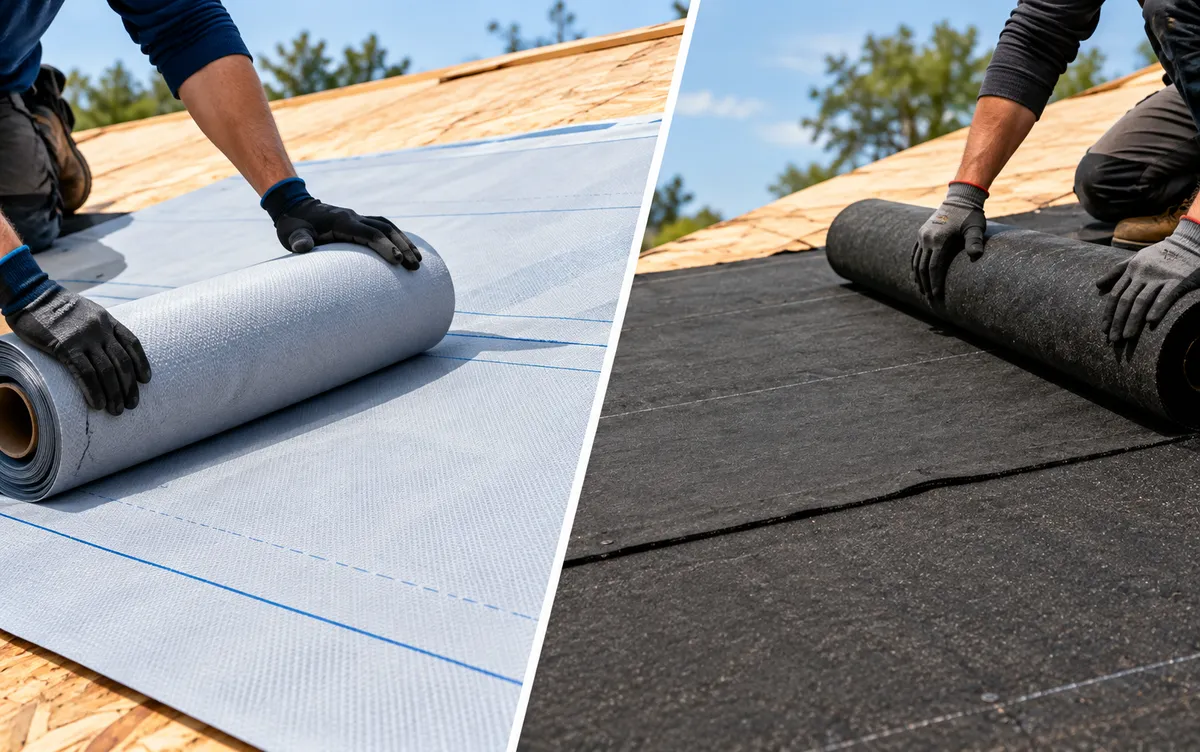
Understanding synthetic vs felt underlayment can help you make a more informed decision about your home's protection, installation quality, and long-term roofing costs. Traditional asphalt felt has been used for decades, while synthetic underlayment offers a modern alternative with different performance characteristics. A third option, self-adhering underlayment, provides additional protection in vulnerable areas of the roof.
For homeowners in Rochester Hills and throughout Southeast Michigan, this decision deserves attention because roofs must handle rain, snow, freezing temperatures, wind, and seasonal temperature changes.
Let's compare the three main roofing underlayment types, explain their advantages and disadvantages, and cover what you should ask your roofer before signing a replacement contract.
What Is Roofing Underlayment?
Roofing underlayment is a protective layer installed over the roof deck and beneath the shingles or other roofing materials. It acts as a secondary barrier against moisture that may get past the outer roofing surface.
Although shingles shed most rain and snow, they do not make every roof completely waterproof under all conditions. Wind-driven rain, damaged shingles, and water backing up beneath shingles can expose the roof deck to moisture. Properly selected and installed underlayment helps protect the underlying wood.
Underlayment also provides temporary protection during roof installation, subject to the product's exposure limits and installation requirements.
It is one part of a complete roofing assembly. The roof deck, drip edge, flashing, ice and water protection, shingles, and ventilation all contribute to the system's overall performance.
For a complete explanation of how these components work together, read our guide to what goes under your shingles and how a complete roof system works.
The Three Main Roofing Underlayment Types
Not all underlayment products are designed for the same purpose. The best option depends on the roof's slope, roofing material, exposure conditions, manufacturer requirements, and budget.
1. Asphalt Felt Underlayment
Asphalt felt is the traditional roofing underlayment commonly called tar paper. It consists of a reinforcing mat saturated with asphalt to provide water resistance. Products are available in different grades, including traditional No. 15 and No. 30 felt classifications.
Advantages of felt underlayment
Generally has a lower upfront material cost.
Has a long history of use in residential roofing.
Is available in established product types that meet applicable roofing standards.
Can be suitable for certain roofing projects when properly specified and installed.
Disadvantages of felt underlayment
Can tear more easily than many synthetic products during installation.
May wrinkle or buckle if it absorbs moisture.
Generally offers less flexibility during installation in challenging weather conditions.
Usually has a shorter permitted exposure period than many synthetic alternatives.
Felt is not automatically a poor choice. It remains a viable option for suitable projects. However, homeowners should understand its limitations and confirm that the selected product meets the roofing manufacturer's requirements.
2. Synthetic Underlayment
Synthetic underlayment is typically made from engineered polymer materials, such as polypropylene or polyester. It was developed to provide an alternative to traditional asphalt felt.
Its strength, weight, surface texture, and exposure rating vary by product. Many synthetic products resist tearing and moisture absorption better than conventional felt, making them useful for modern roof replacement projects.
Advantages of synthetic underlayment
Often provides greater tear resistance than traditional felt.
Is lightweight and relatively easy for roofing crews to handle.
Generally resists moisture absorption and the wrinkling associated with wet felt.
Many products allow longer exposure to sunlight before the roofing covering must be installed.
Can provide useful traction features, depending on the surface design.
Potential disadvantages
Typically costs more than basic felt.
Performance differs significantly between products and manufacturers.
Some surfaces can become slippery when wet, icy, or dusty.
Must be installed using the specified fasteners, lap dimensions, and exposure limits.
Synthetic underlayment is often a strong choice for asphalt shingle replacement, particularly when durability during installation and resistance to tearing are priorities. However, do not assume every synthetic product performs equally well. Ask for the manufacturer's name, product model, technical specifications, and installation instructions.
3. Self-Adhering Underlayment
Self-adhering underlayment is a membrane with an adhesive backing that bonds to a properly prepared roof deck. Many products use modified bitumen and are designed to provide enhanced waterproofing in vulnerable locations.
Unlike conventional felt and many synthetic products, qualifying self-adhering membranes can seal around properly installed fasteners. This makes them particularly useful in areas where water intrusion is a greater concern.
Common applications include:
Roof eaves that may be affected by ice dams.
Valleys where water flows from adjoining roof slopes.
Areas around certain roof penetrations and transitions.
Low-slope areas where the selected roofing system requires additional protection.
Self-adhering underlayment generally costs more than standard felt or synthetic underlayment. Installation may also require specific surface preparation and temperature conditions.
It is not necessarily intended to replace the standard underlayment across the entire roof. The appropriate coverage depends on the roofing assembly, local requirements, and manufacturer instructions.
Synthetic vs. Felt Underlayment: Key Differences
The following comparison highlights the main trade-offs homeowners should consider.
Feature | Asphalt felt | Synthetic underlayment | Self-adhering membrane |
|---|---|---|---|
Initial material cost | Generally lower | Generally higher | Generally higher |
Tear resistance | Varies by grade | Often higher | Varies by product |
Moisture behavior | Can absorb moisture and wrinkle | Generally resists moisture absorption | Designed for enhanced waterproofing |
Installation handling | Can tear or wrinkle | Often lightweight and durable | Requires careful surface preparation |
Sunlight exposure | Usually more limited | Often longer, product-dependent | Product-dependent |
Typical application | Underlayment beneath roofing | Underlayment beneath roofing | Eaves, valleys, and other vulnerable areas |
Main consideration | Budget and correct installation | Product quality and fastening | Coverage, compatibility, and installation conditions |
These are general comparisons, not guarantees for every product. Always check the specific product's technical data sheet and installation instructions before making a decision.
Which Underlayment Is Best for Michigan Homes?
For homeowners in Rochester Hills, choosing underlayment means considering more than the initial price. Southeast Michigan experiences winter freezing, thawing, snow, rain, and occasional strong winds. These conditions make correct installation and moisture management especially important.
Synthetic underlayment for general roof coverage
Synthetic underlayment can be a practical choice for many asphalt shingle roof replacements because of its tear resistance and handling characteristics. It can also provide a longer installation exposure window than many felt products, which may help when weather interrupts a roofing project.
However, the crew must still follow the product's fastening pattern, overlap requirements, and maximum exposure period.
Self-adhering protection at vulnerable areas
Ice dams can form when snow melts and refreezes near the roof's colder edges. Water may then back up beneath the shingles and enter vulnerable parts of the roof assembly.
Where required by applicable code, an ice barrier helps protect against this type of water intrusion. Michigan's applicable residential code provisions specify ice-barrier requirements for qualifying roofs in areas with a history of ice formation at the eaves. The required placement and extent depend on the applicable code and roof conditions.
A roofer should explain where self-adhering protection will be installed and how the proposed coverage meets applicable requirements.
Felt for suitable projects
Felt may still make sense when the product is appropriate for the roof, the installation conditions are suitable, and the roofing manufacturer's requirements are met.
The important point is to evaluate the complete installation rather than assuming that one material is always suitable for every roof.
How Much Does Synthetic vs. Felt Underlayment Cost?
Felt generally has a lower material cost than synthetic underlayment. Self-adhering membranes often cost more per unit of coverage than either standard option.
However, the price difference on a complete roof replacement depends on more than the roll price. Your contractor may also account for roof dimensions, slope, valleys, penetrations, waste, labor, fastening materials, and the amount of specialized membrane required.
For an accurate comparison, ask your roofer to explain the underlayment cost as part of the complete roofing estimate rather than looking at material prices in isolation.
What affects the total cost?
Roof size and complexity: Larger roofs require more coverage, while complicated rooflines may need additional cutting, overlapping, and detailing.
Product grade: Premium synthetic products can cost more than basic synthetic options. Felt products also differ by grade and specification.
Installation labor: Steep slopes, difficult access, and detailed roof transitions can increase installation time.
Self-adhering coverage: Extensive ice-and-water protection or additional membrane around valleys and penetrations can increase material and labor costs.
Manufacturer requirements: A particular shingle system may specify compatible underlayment products or installation methods. These requirements can influence the final estimate and available warranty coverage.
A lower-priced estimate is not necessarily a better deal if it excludes necessary materials or installation steps. Compare the written scope of work, not just the final total.
Does Underlayment Affect Your Roof Warranty?
It can. Roofing warranties vary by manufacturer and product, and some enhanced system warranties require particular components or approved installation practices.
Before choosing felt or synthetic underlayment, ask your roofer to confirm that the proposed product is compatible with your shingles and the warranty coverage being offered.
Review these details:
The specific underlayment product and manufacturer.
Whether the product satisfies the shingle manufacturer's installation requirements.
Whether any enhanced system warranty requires particular components.
The permitted exposure period before shingles are installed.
The required fastening pattern, overlap, and roof-slope limitations.
Any separate workmanship warranty provided by the contractor.
Do not assume that using synthetic underlayment automatically provides a longer shingle warranty or that felt automatically disqualifies a roof from coverage. The actual terms depend on the products and warranty program involved.
What Should You Ask Your Roofer Before Installation?
A reliable roofing proposal should make it clear what materials will be installed beneath your shingles.
Before approving the work, ask these questions:
Which underlayment will you use? Request the product name and model instead of accepting a generic description.
Where will self-adhering membrane be installed? Confirm the planned coverage at eaves, valleys, and other areas that require additional protection.
How will the underlayment be fastened? Ask whether the proposed fasteners and spacing follow the product instructions.
How long can the material remain exposed? This matters if rain or other delays interrupt the installation.
Does the product meet the shingle manufacturer's requirements? Ask how it relates to any system warranty being offered.
What happens if the roof deck is damaged? Confirm how concealed damage and any additional decking replacement will be handled and priced.
The answers should be reflected in the written estimate or installation specifications. This helps you compare contractors fairly and reduces the chance of unexpected changes during the project.
Final Verdict: Synthetic or Felt Underlayment?
For many modern asphalt shingle roofs, synthetic underlayment is an attractive option because it commonly offers improved tear resistance, lower moisture absorption, and convenient handling compared with traditional felt.
Felt remains a reasonable choice for suitable projects where cost is a priority and the material meets the applicable installation and warranty requirements. Self-adhering underlayment serves a different role by providing enhanced waterproofing in vulnerable roof areas.
For Michigan homeowners, the best solution may combine synthetic underlayment over the general roof deck with self-adhering ice protection where required or appropriate. The right specification depends on the roof design, roofing materials, local requirements, and manufacturer instructions.
Before approving a roof replacement, ask your contractor to identify every underlayment product in the estimate and explain where each will be installed. A well-planned roof system is about more than the shingles you can see; the protective layers beneath them matter too.
If you're planning a roof replacement in Rochester Hills, review our guide to the complete roof system and what goes under your shingles to understand how the different components work together.
Frequently Asked Questions
Is synthetic underlayment better than felt?
Synthetic underlayment often offers greater tear resistance, lower moisture absorption, and a longer permitted exposure period than traditional felt. Felt generally costs less and can still be suitable when properly specified and installed. The better choice depends on the roof, the product, and the manufacturer's requirements.
What is the difference between tar paper and synthetic underlayment?
Tar paper is the common name for asphalt-saturated felt underlayment. Synthetic underlayment is made from engineered polymer materials. Synthetic products often resist tearing and moisture absorption better, while felt typically has a lower initial material cost.
Is self-adhering underlayment necessary?
Self-adhering underlayment is required in certain applications by applicable codes or roofing specifications and is commonly used at vulnerable locations such as eaves and valleys. The exact coverage depends on local requirements, roof design, and manufacturer instructions.
Does synthetic underlayment cost more than felt?
Synthetic underlayment generally costs more per unit of material than basic asphalt felt. The total difference in a roof replacement depends on roof size, product selection, labor, and the amount of additional waterproofing required.
Does roofing underlayment affect the warranty?
Yes, it can. Some roofing manufacturers require approved components and installation methods for particular warranty programs. Ask your contractor to confirm the selected underlayment meets the requirements for your specific shingle system.
Can felt underlayment be used in Michigan?
Felt can be suitable for certain Michigan roofing projects when it meets applicable code requirements and the roofing manufacturer's specifications. The contractor must also address any required ice-barrier protection and other roof-specific installation details.
How long can synthetic underlayment remain exposed?
The permitted exposure period varies by product. Some synthetic products are rated for extended exposure to sunlight, but the rating is not universal. Follow the manufacturer's technical data and install the roofing covering within the stated time limit.
Should I use synthetic underlayment and ice-and-water protection together?
Many roofing systems use standard underlayment across the roof deck and a self-adhering ice-and-water membrane in vulnerable areas. The combination can provide complementary protection, but the exact materials and coverage should follow applicable code, roof design, and manufacturer requirements.