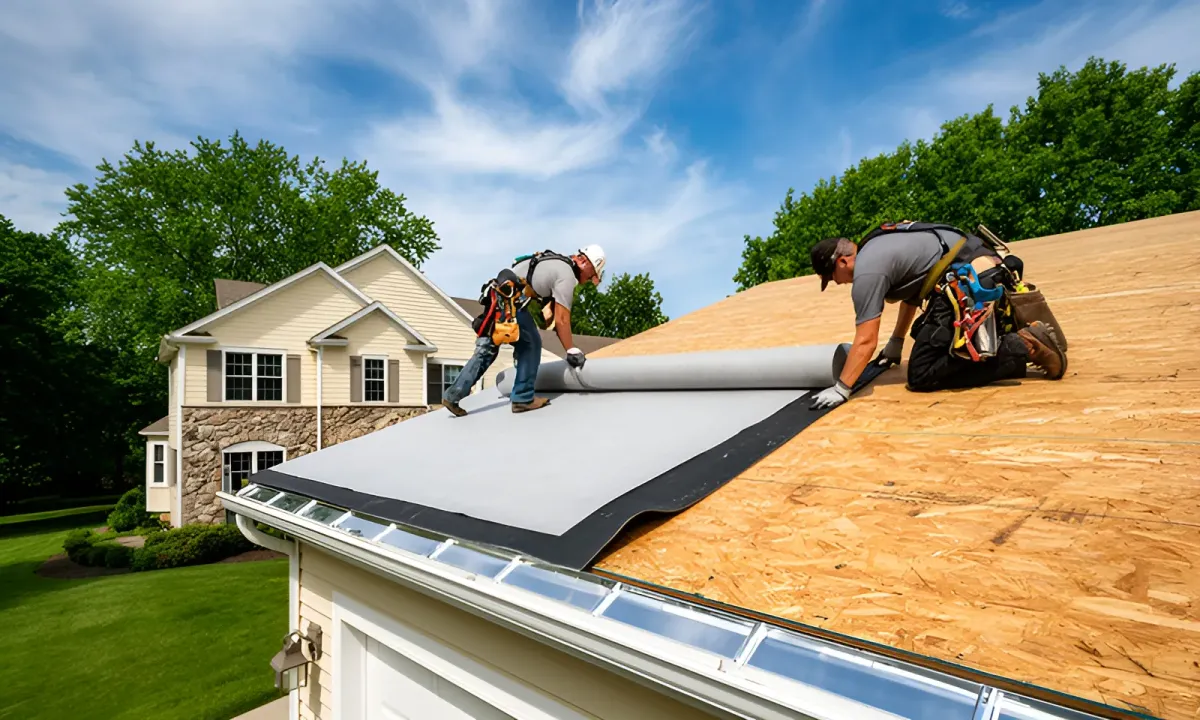
Roof Underlayment and Ice and Water Shield: What Goes Under Shingles
When homeowners compare roofing estimates, most of the attention goes to the shingles. The color, the style and the brand are what you see from the street.
But some of the most important parts of your roof are the layers you will never see once the job is finished.
Roof underlayment and ice and water shield sit between the wood deck and the shingles. In Michigan, where ice dams, wind-driven rain and freeze-thaw cycles are part of every year, those hidden layers can decide whether a small problem stays small or turns into a leak.
This guide explains what roof underlayment does, how felt and synthetic products compare, where ice and water shield belongs, and what to ask your contractor before installation begins.
What Is Roof Underlayment?
Roof underlayment is a water-resistant layer installed directly on the roof deck, under the shingles. It acts as a secondary barrier, helping to keep water away from the wood if wind, ice or damage lets moisture get past the shingles. It also protects the deck during installation and helps shingles lie flat.
Shingles are the primary weather barrier. Underlayment is the backup.
Most residential roofs use two kinds of protection under the shingles: a general underlayment across the whole roof, and a self-adhered membrane (ice and water shield) in the most leak-prone areas.
Why Underlayment Matters on a Michigan Roof
A roof in southeast Michigan faces conditions that can push water where it does not belong.
The main risks include:
Ice dams: meltwater refreezes at the eaves and can back up under shingles.
Wind-driven rain: strong storms can push water sideways under shingle edges.
Freeze-thaw cycles: water that seeps into small gaps expands when it freezes.
Hail and wind damage: lost or cracked shingles expose what is underneath.
Good underlayment does not make a roof leakproof, but it gives the system an important second line of defense.
Types of Roof Underlayment
There are three main categories of underlayment used on residential roofs. Each has a different job and price point.
Asphalt-Saturated Felt
Felt underlayment, often called tar paper, is made from a mat saturated with asphalt. It has been used for decades and is commonly sold in lighter and heavier weights.
Felt is usually the lowest-cost option. It can tear more easily, may wrinkle when it absorbs moisture, and is heavier to carry onto the roof.
Synthetic Underlayment
Synthetic underlayment is made from woven or spun polymer materials. It has become the standard choice on many re-roofing projects.
Common advantages include:
Higher tear resistance than most felt products
Lighter weight and larger rolls, which can speed installation
Less wrinkling when exposed to moisture
Better walking traction on many products
Synthetic underlayment usually costs more than felt, and products vary widely in quality. Check the manufacturer's specifications for UV exposure limits and fastening requirements.
Self-Adhered Membrane (Ice and Water Shield)
Ice and water shield is a self-adhered membrane, usually made with rubberized asphalt or a similar compound. It sticks directly to the roof deck and seals around nails driven through it.
It is the most water-resistant of the three, and it is also the most expensive. That is why it is normally used in specific areas rather than across the entire roof.
Roof Underlayment Comparison Table
The table below summarizes how the main options generally compare. Specific products can differ, so review the manufacturer's data sheet.
Underlayment Type | Water Resistance | Relative Cost | Typical Use |
|---|---|---|---|
Asphalt-saturated felt | Good | Lowest | Budget installs, some older practices |
Synthetic underlayment | Very good | Moderate | Main roof field on most re-roofs |
Ice and water shield | Highest; self-sealing | Highest | Eaves, valleys, penetrations, low slopes |
What Is Ice and Water Shield?
Ice and water shield is a waterproof membrane designed for the parts of a roof where water is most likely to get in. Unlike felt or synthetic underlayment, it bonds to the deck instead of simply lying on top of it.
That bond matters. When an ice dam forces water uphill under the shingles, a membrane that seals around fasteners can help stop that water from reaching the deck and the home.
It is not a cure for the causes of ice dams. Attic insulation and ventilation still play the biggest role in preventing them.
Where Ice and Water Shield Should Be Installed
Placement is where good installations stand apart. These are the areas where contractors commonly use ice and water shield.
1. Along the Eaves
The eaves are where ice dams form. Many building codes based on the International Residential Code call for an ice barrier at the eaves in areas where ice dams are a known problem, extending a set distance up the roof past the inside of the exterior wall. Check the exact requirement with the City of Rochester Hills or your local building department.
On homes with wide overhangs or low slopes, extending the membrane further up the roof may provide extra protection.
2. In Valleys
Valleys channel water from two roof planes into one path. That concentrated flow makes them a frequent leak point, so many installers line them with a self-adhered membrane.
3. Around Chimneys, Skylights and Vents
Every roof penetration is a potential entry point for water. A membrane around these openings works together with flashing to seal the area.
4. Along Walls and Dormers
Where a roof meets a vertical wall, water can be driven behind step flashing. Membrane at these transitions adds another layer of protection.
5. On Low-Slope Sections
Shallow roof areas drain more slowly and hold snow longer. Shingle manufacturers often require extra underlayment protection on lower slopes, so check their installation instructions.
How Roof Underlayment Is Installed
Underlayment is installed after the old roofing is removed and the deck is inspected and repaired. A typical sequence looks like this:
Install drip edge along the eaves according to the manufacturer's sequence.
Apply ice and water shield along the eaves, starting at the lowest edge.
Line valleys and seal around penetrations with membrane.
Roll out synthetic or felt underlayment across the rest of the roof, overlapping each row.
Fasten the underlayment using the method and spacing the manufacturer specifies.
Install flashing, starter strips and shingles.
Each step builds on the one before it, with every layer lapping over the one below so water runs downhill and out. Our guide to the roof installation process explains how underlayment fits into the full project.
Practical tip: Ask your contractor to share photos of the deck, underlayment and ice and water shield before the shingles go on. Once the roof is finished, those layers are impossible to check.
Can Underlayment Be Added Without a Tear-Off?
Ice and water shield works best when it adheres directly to a clean, dry deck. That is difficult to achieve when new shingles are installed over an old layer.
This is one of the main reasons many Michigan homeowners choose a full tear-off. Our comparison of roof overlay vs tear-off covers the trade-offs in more detail.
Roof Underlayment for New Construction vs Re-Roofing
The materials are similar, but the situations differ.
New Construction
On a new home or addition, the deck is fresh and the underlayment plan is set by the builder, the design and local code. Inspections may check underlayment and ice barrier placement before the roof covering goes on. Our article on new construction roofing in Oakland County covers the planning and permit side.
Re-Roofing
On a replacement, the underlayment plan often depends on what the crew finds under the old shingles. Damaged decking must be replaced before new underlayment goes down, and older homes may need more membrane at problem areas than the original roof had.
Does Underlayment Affect Your Roof Warranty?
It can. Many shingle manufacturers offer stronger system warranties when the roof uses their matching underlayment, starter strips, ridge caps and ventilation products.
Important: Warranty terms differ by manufacturer and product line. Ask your contractor which warranty applies to your roof and get the details in writing.
Workmanship matters too. Underlayment installed with poor overlaps or the wrong fasteners may not perform as intended, regardless of the product quality.
Questions to Ask Your Roofing Contractor
Underlayment is often listed as a single line in an estimate. These questions can help you understand what you are paying for:
Which underlayment will you use on the main roof, felt or synthetic?
Where will you install ice and water shield, and how far up from the eaves?
Will the valleys and all penetrations get membrane?
Are the underlayment products from the same manufacturer as the shingles?
How does your choice of underlayment affect the warranty?
Will you send photos of the underlayment before shingles go on?
Roof Underlayment Checklist
Before you sign an estimate, make sure it clearly addresses these points:
Type and brand of underlayment for the main roof
Ice and water shield at the eaves, with coverage distance stated
Membrane in valleys and around chimneys, skylights and vents
Drip edge at eaves and rakes
Decking inspection and replacement pricing
Warranty coverage and the products it requires
If you are also planning work on gutters, siding or windows, our partner company Prime Home Remodeling provides residential roofing and exterior remodeling across southeast Michigan.
Get Professional Advice on Your Roof Underlayment
Roof underlayment and ice and water shield are easy to overlook in an estimate, but they do a lot of the work that keeps water out of your home. In Michigan, the right membrane at the eaves, valleys and penetrations can make a real difference during ice dam season and heavy storms.
The best protection comes from quality materials, correct placement and careful installation working together.
If you live in Rochester Hills or elsewhere in Oakland County, learn more about our roof installation services, or request a free roof inspection and quote to talk through the right underlayment plan for your home.
Frequently Asked Questions
What is roof underlayment made of?
Roof underlayment is usually made of asphalt-saturated felt, synthetic polymer fabric, or a self-adhered rubberized asphalt membrane. Felt is the traditional low-cost option, synthetic is common on modern re-roofs, and self-adhered membrane is used in leak-prone areas such as eaves and valleys.
Is synthetic underlayment better than felt?
Synthetic underlayment is often better than felt for tear resistance, weight and resistance to wrinkling. It usually costs more, and quality varies between products. Felt can still perform well when installed correctly. Check the shingle manufacturer's requirements before choosing.
Do I need ice and water shield in Michigan?
Ice and water shield is widely used in Michigan because ice dams are common. Many codes based on the International Residential Code require an ice barrier at the eaves in areas with a history of ice dams. Confirm the current requirement with your local building department.
Should ice and water shield cover the whole roof?
Ice and water shield does not usually need to cover the whole roof. It is normally installed at the eaves, valleys, penetrations and low-slope areas. Full coverage adds cost and can affect how moisture moves through the roof system, so follow manufacturer guidance and your contractor's recommendation.
How long does roof underlayment last?
Roof underlayment usually lasts as long as the roof covering when it is protected by shingles and installed correctly. Most underlayment is replaced during a full tear-off. Exposure to sun before the shingles go on can shorten its life, so manufacturers set limits on how long it can stay uncovered.
Can you install new shingles over old underlayment?
Installing new shingles over old underlayment is common during an overlay, but it means the old layer and the deck cannot be inspected or upgraded. During a tear-off, the old underlayment is removed so new materials, including ice and water shield, can bond directly to the deck.
Does underlayment stop ice dams?
Underlayment does not stop ice dams from forming. Ice dams are mainly caused by heat escaping into the attic and melting snow. Ice and water shield helps reduce the chance that water from an ice dam leaks into the home, while insulation and ventilation address the cause.
Is roof underlayment required by code?
Roof underlayment is generally required by codes based on the International Residential Code for asphalt shingle roofs, along with an ice barrier in areas prone to ice dams. Specific product and placement rules can change, so check with the City of Rochester Hills or your local building department.
How much does roof underlayment add to the cost of a new roof?
Roof underlayment is usually a modest share of the total cost of a new roof. Synthetic products and wider ice and water shield coverage cost more than basic felt. Ask for an itemized estimate that lists the underlayment type and coverage so you can compare quotes fairly.